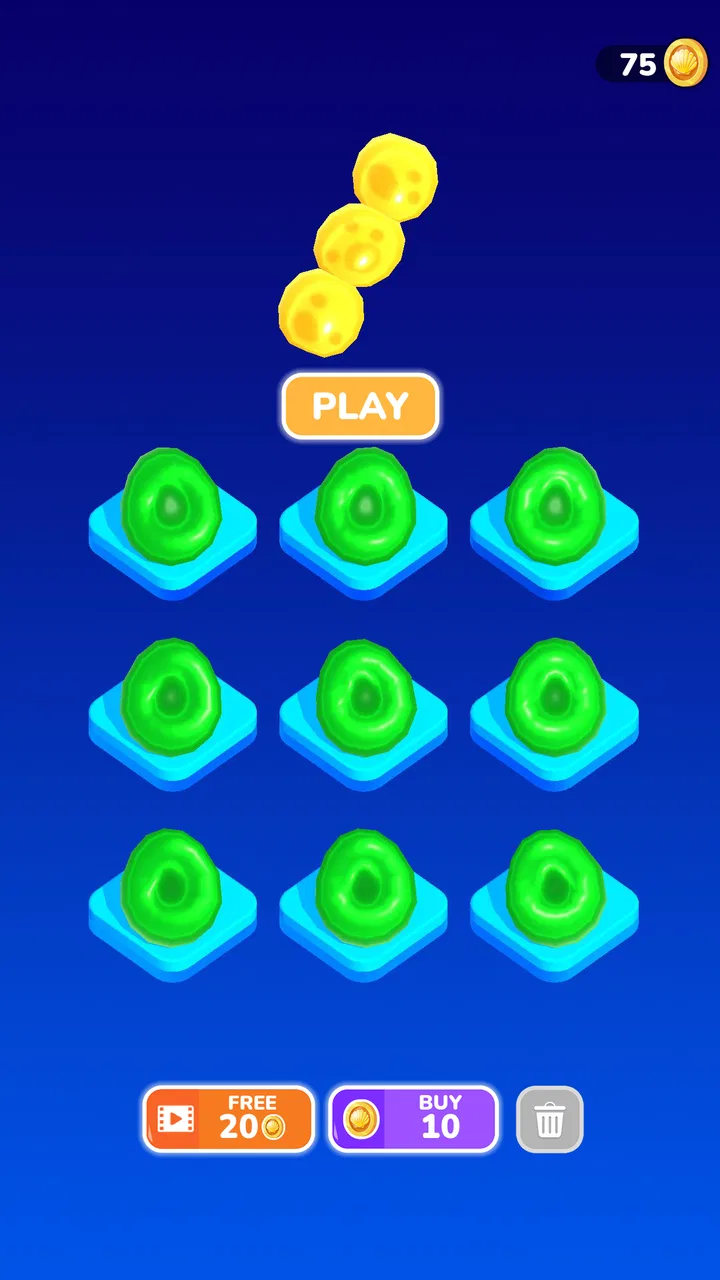
Evolution Merge - Eat and Grow
- 4.5
- Rating
- 10.00M
- Installs
- Free
- Price

 Analysis by App-foxy
I went into Evolution Merge - Eat and Grow expecting a simple arcade time-killer, and that is exactly where it works best. The first few moments are easy to understand: move through a food-chain setting, look for something you can consume, grow from that success, and stay alert because a larger creature may be looking at you in the same way. The idea is familiar, but the appeal comes from how quickly the game turns one small decision into the reason for another attempt.
This is a free arcade game from SayGames Ltd, available for Android devices running version 8.0 or later. It is rated for Everyone 10+, and the current version is 1.2.22. The large audience is easy to understand: the game has passed over 10 million installs and holds an average rating of 4.5 from around 164 thousand ratings. Those figures do not guarantee that every player will enjoy it, but they do match my impression that this is designed for short, accessible sessions rather than a demanding long-form adventure.
Why the first move is so easy to understand
The strongest part of the opening is that it does not ask me to learn a complicated system before giving me something to do. I can begin with a clear objective, act immediately, and see the result of that action without waiting through a long explanation. That makes the game suitable for a quick break, especially when I want something more interactive than scrolling but do not have the concentration for a strategy game.
You May Also Like

 Blood Strike: 2.5 Anniversary
Blood Strike’s Loadouts Turn Every Drop Into a Tactical Gamble
A close look at Blood Strike’s custom loadouts: how fast access to signature weapons reshapes its battle royale rhythm, rewards preparation, and narrows the gap between fights.

 Pandora - Music & Podcasts
Pandora’s Music Is Easy to Start, but Harder to Recover
Pandora’s strength is its low-effort path from a seed to a station. Its weak spot is how much confidence it asks you to place in connection, setup, and quiet recovery.

 8 Ball Pool
 Is Built on Rivalries, Rematches, and Routine
A close look at the rivalries, rematches, shared routines, and unanswered safety questions that turn a quick pool match into a persistent mobile community.

 Samsung Music
’s Quiet Strength Is Playing What You Already Own
Its reach comes less from spectacle than from dependable access to a personal library. That simplicity is both the app’s strongest retention engine and its ceiling.

 AccuWeather: Weather Radar
AccuWeather Review: A Quick, Clear Forecast for Everyday Decisions
For everyday plans, the best forecast is the one you can understand quickly. AccuWeather makes rain timing, radar, and local conditions easy to act on, with a few trade-offs.

 Hill Climb Racing
Why Hill Climb Racing Still Turns Crashes Into One More Run
A tiny car, a bumpy hill and one more upgrade: Hill Climb Racing keeps resurfacing because its simple chaos makes every near-miss feel personal.
More From Our News Desk



The food-chain theme gives the basic movement more purpose than a completely abstract collection game would have. I am not simply gathering identical objects from a blank screen; I am trying to judge what belongs within reach and what represents danger. That distinction matters because the same environment can contain both an opportunity and a threat. The game’s central question is always practical: can I safely take the next thing, or am I about to become the meal?
My advice for a new player is to resist the urge to move constantly during the first session. Use the early moments to understand the relationship between size, targets, and danger. The most useful habit is to scan before committing, rather than reacting only after an obstacle or predator is already close. That small pause makes the game feel less random and gives the opening action a little more control.
The controls are aimed at immediacy, not precision simulation. That is a good match for an arcade title, but it also means players who want delicate movement or deep character handling may find the experience light. I enjoyed the fact that I could pick it up without preparation, although I also noticed that the simplicity leaves less room for mastery than in a more technical arcade game.
The feedback rhythm keeps the loop moving
Once I make the first successful move, the game establishes its rhythm quickly: act, consume or advance, become more capable, then search for the next safe opportunity. The feedback is easy to read because progress is tied directly to what I do on the screen. A successful encounter feels useful immediately, while a poor choice can end the run and send me back to the beginning of the loop.
That rhythm is the main reason another session starts. I am rarely returning because of a long narrative mystery or a complicated build. I return because the previous attempt ended just before I had fully adapted to the situation. The thought is usually, “I understand what caught me that time; I can make a better choice now.” For a short arcade game, that is a more effective motivation than a large collection of menus.
The danger is that repetition can become visible fairly quickly. Players who need constant new mechanics, story scenes, or a broad selection of modes may feel that the core action does not change enough. I would not choose this as my main game for a long evening. It is better at creating several compact attempts than at sustaining a marathon session.
There is also a useful trade-off in the way the game presents risk. If every target were safe, growth would become a routine collection task. If every encounter were harsh, the game would feel frustrating rather than playful. The appeal comes from moving between those extremes: I want to grow, but I also need to recognize that growth does not make every nearby object harmless. That tension gives the basic action its character.
For an everyday example, I can imagine playing while waiting for a coffee order or sitting on a short train journey. I have enough time to make a few decisions, but I do not need to remember a complex quest or keep a long sequence in my head. If the session ends, I can put the phone away without losing the whole evening. When I pick it up again, the basic objective is still clear.
Growth feels rewarding because it changes the next choice
The reward is not only the visual sense of getting bigger. The more important reward is that growth changes what I consider possible. A target that looked unsafe or unreachable earlier may become worth considering later, so the environment gains a changing hierarchy. That makes each successful action feel like preparation for the next decision rather than a disconnected point on a score counter.
I found it helpful to treat growth as permission to reassess, not as a reason to become careless. A larger form can open new opportunities, but the food-chain premise still suggests that something higher up may threaten me. The best runs come from combining confidence with caution. I move forward because I have improved, but I continue checking the surroundings because improvement is not the same as invulnerability.
This is one of the game’s more interesting design choices for such a casual experience. The reward does not require a complicated upgrade tree to be understandable. The action itself explains the benefit. I eat, I grow, and the next part of the run becomes more interesting because the set of possible choices changes. That direct connection is satisfying, especially for players who dislike games that hide progress behind too many currencies or screens.
At the same time, anyone looking for detailed customization should adjust expectations. This is not the kind of arcade game I would recommend for building a highly personal character or planning a long-term loadout. Its pleasure comes from immediate transformation within a run, not from spending a lot of time preparing between runs.
The free entry point is helpful here. I can try the complete basic loop without paying first, which makes the decision to install relatively easy. There are in-app purchases ranging from $2.99 to $49.99 per item, so I would recommend checking the purchase prompts carefully and deciding in advance whether I want to spend anything. For me, the game is easiest to enjoy when purchases remain optional rather than becoming part of the moment-to-moment decision-making.
What happens when a run resets
The reset is not just a punishment; it is the mechanism that turns a mistake into another round. When I lose progress, the game gives me a reason to reinterpret the previous attempt. Did I move too quickly? Did I choose a target without considering what could reach me? Did I assume that getting larger removed the need to watch the environment? Those questions are simple, but they make the restart feel more purposeful than pressing replay without learning anything.
Still, the reset can be the point where patience matters. Players who dislike repeating an opening sequence may find the loop restrictive, particularly if they want every attempt to begin with a fresh challenge. This is where a traditional arcade alternative may be a better fit: a game with fixed stages, clearly separated levels, or a more formal progression can make failure feel like movement through a larger structure. Here, the pleasure is more cyclical and immediate.
I also would not recommend it to someone seeking a relaxing game with no pressure. The controls and objective are approachable, but the threat of being eaten gives the session a constant edge. Even when the presentation feels playful, the decision to approach or avoid something can end the run. If you prefer puzzle games that let you think without time-sensitive danger, a slower alternative will probably suit you better.
On the other hand, the reset is a strength for people who enjoy learning through quick mistakes. I can test an idea, see the consequence, and try again without committing to a large campaign. That makes the game a good companion for fragmented free time. It is also a practical choice for younger players within the Everyone 10+ rating, provided parents are comfortable with the arcade-style eating and chase theme and with the presence of optional purchases.
Small habits that make the next attempt better
The first useful habit is to separate safe growth from greedy growth. When I see an easy opportunity, taking it may be better than rushing toward a more valuable-looking target that places me near a larger threat. The game rewards the ability to keep a run alive, not merely the desire to take the biggest available chance immediately.
The second is to use the start of a run as reconnaissance. Rather than treating the opening as disposable, I pay attention to how the environment is arranged and which encounters tend to create trouble. This matters because the reset becomes more valuable when I carry a specific lesson into the next attempt. A vague feeling that I “almost made it” is less useful than identifying the exact decision that ended the run.
The third is to stop after a frustrating streak instead of assuming that another immediate attempt will fix it. Because the loop is compact, it is easy to press on repeatedly, but impatience can make me choose targets too aggressively. A short pause often helps me return with a clearer sense of distance and risk. That is a small real-world advantage of the format: the game is easy to leave and easy to resume.
A fourth tip is to judge success by improved decisions, not only by how far the run goes. Some attempts teach me how to approach a threat or when to wait, even if they end earlier than I hoped. That mindset keeps the reset from feeling like wasted time. It also reveals the game’s limit: if I do not enjoy repeating decisions and refining instincts, the central appeal may wear thin.
Where it stands among arcade alternatives
Compared with a standard endless runner, this game puts more emphasis on choosing what to approach than on simply avoiding a fixed stream of obstacles. The food-chain idea gives progress a clear direction: I am trying to move upward through what I can consume while remaining aware of what can consume me. That creates more interaction with the environment than a purely forward-running design.
Compared with a merge-focused puzzle game, the action is more immediate and less dependent on arranging a board or planning a chain of combinations. The “merge” idea in the short description points toward evolution and growth, but my experience of the core appeal is active movement and survival rather than quiet tile management. Players looking for a thoughtful, stationary puzzle will likely prefer the usual match or merge alternatives.
Compared with a large progression-based mobile game, this one is much easier to understand but also less substantial. I do not need to maintain a complicated roster, learn a long story, or schedule a lengthy session. In exchange, I should not expect the same depth, variety, or sense of a permanent adventure. The right comparison depends on what I want from my phone: quick arcade feedback or a game that becomes a major hobby.
SayGames Ltd has positioned this as a free, approachable experience, and that identity comes through in the design. It is not trying to replace a console-style campaign. It is trying to make the next action obvious, the reward immediate, and the restart tempting. For that purpose, the simplicity is mostly a strength, although it becomes a weakness for players who need extensive content variation.
Who should install it, and who should skip it
I would recommend it to someone who likes short arcade sessions, clear cause-and-effect, and the satisfaction of turning a small creature into a stronger one through direct action. It is especially suitable for players who enjoy learning a simple rule set and then testing their judgment under pressure. The free price makes it easy to sample, while the broad install base and strong average rating suggest that the format has connected with many mobile players.
I would skip it if my priority were a deep story, detailed strategy, elaborate customization, or a calm game with no threat of sudden failure. I would also look elsewhere if I wanted a carefully structured level campaign where every stage introduces a distinct mechanic. This game’s identity is the repeatable food-chain loop, not a wide collection of unrelated activities.
The age rating of Everyone 10+ is worth keeping in mind. The concept is cartoonish and accessible, but the act of eating smaller creatures and avoiding larger ones is still central to the experience. For families, I would also explain that the game is free to start but includes optional in-app items. That conversation is more useful than assuming that a free download has no spending considerations.
My verdict on the action-feedback-reset cycle
After spending time with it, I see Evolution Merge - Eat and Grow as a focused arcade game built around a clean sequence: choose an action, receive immediate feedback, enjoy the reward of growth, face the consequences of a mistake, and begin again with a slightly better understanding. That loop is tangible, and the reason to start another session is clear rather than forced.
Its best quality is the way growth changes the next decision without burying the player under complicated systems. Its main weakness is the same simplicity: once the central pattern is familiar, players who need constant novelty may feel they have reached the edge of what it offers. I enjoyed it most in short bursts, when I wanted a game that could begin immediately and end without ceremony.
For me, the final recommendation is straightforward. Try it if the idea of climbing a food chain through quick choices sounds fun, especially when you have only a few minutes to play. Keep your expectations modest about depth, watch the optional purchase prompts, and treat every reset as information rather than failure. If that style of repetition feels rewarding, this free arcade game can become an easy little habit; if you want a broader adventure, a more structured alternative will serve you better.
FAQs for Evolution Merge - Eat and Grow
01What is Evolution Merge - Eat and Grow about?
Evolution Merge - Eat and Grow is a strategic puzzle game where players merge creatures to evolve them into stronger beings. The goal is to eat smaller organisms while avoiding predators. The game offers a captivating blend of strategy and casual gameplay, making it engaging for players of all ages.
02How do I play Evolution Merge - Eat and Grow?
To play Evolution Merge - Eat and Grow, you need to merge identical creatures on the board to evolve them into more advanced species. As you progress, the challenge increases with more complex organisms. It's crucial to plan your moves carefully to grow your creatures while avoiding larger predators.
03Are there in-app purchases in Evolution Merge - Eat and Grow?
Yes, Evolution Merge - Eat and Grow offers in-app purchases. Players can buy additional coins or power-ups to enhance their gameplay experience. While these purchases can speed up progression, they are optional, and players can enjoy the game without spending money by progressing at their own pace.
04Is Evolution Merge - Eat and Grow suitable for children?
Evolution Merge - Eat and Grow is family-friendly and suitable for children. The game has a simple interface and engaging visuals that appeal to younger audiences. However, parental guidance is advised for in-app purchases to ensure children do not make unintended transactions while playing.
05Does Evolution Merge - Eat and Grow require an internet connection?
Evolution Merge - Eat and Grow primarily offers offline gameplay, allowing players to enjoy the game without an internet connection. However, some features, such as leaderboard rankings and certain updates, may require online access to function properly.
Pros
- Addictive gameplay with endless merging possibilities.
- Vibrant graphics enhance the overall experience.
- Simple controls make it accessible for all ages.
- Regular updates with new creatures and features.
- Offline play available
- perfect for travel.
Cons
- In-app purchases can become expensive over time.
- Ads can be intrusive and disrupt gameplay.
- Can become repetitive after extended play.
- Some levels require significant grinding.
- Limited social features for competitive play.

Evolution Merge - Eat and Grow
Gallery